
Blog
How SLA 3D Printing Services Deliver High-Precision Prototypes

In product development, precision is often the difference between a successful prototype and a costly redesign.
Prototypes fail at one thing more than anything else. They are close but not accurate enough to trust. A dimension that is off by half a millimetre ruins a fit test. A surface that loses fine detail makes visual review pointless. SLA 3D printing exists specifically for situations where close is not good enough.
The Basic SLA Process
Our system uses MSLA (Masked Stereolithography) technology. An LCD screen selectively exposes liquid resin to UV light, curing each layer until the part is complete.
This process delivers smooth surfaces, fine details, and high precision for prototype development.
Why SLA Parts Come Out Accurate
Several factors contribute to the accuracy of MSLA printing.
High LCD Resolution
The LCD screen precisely controls where resin is cured, allowing fine details and accurate feature reproduction.
Thin Layer Heights
Layers as thin as 25 microns reduce visible layer lines and improve surface quality.
Low Resin Shrinkage
Photopolymer resins experience minimal shrinkage during curing, helping parts maintain their intended dimensions.
Post-Curing
UV post-curing completes the curing process, improving strength, stability, and dimensional accuracy.
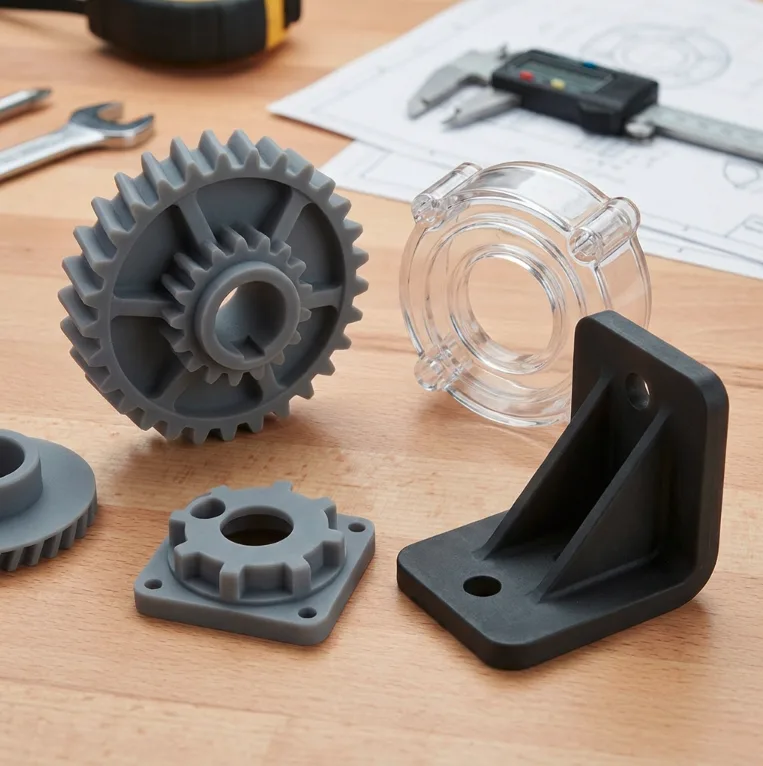
Resin Types and When to Use Each
Choose the right resin for the best balance of appearance, strength, and performance. Dwart Industries offers three resin options:
- Standard Resin
Ideal for concept models, design validation, and visual prototypes. It provides excellent detail and a smooth surface finish, making it suitable for presentations and product reviews. - Tough Resin
Designed for functional prototypes that require greater strength and durability. It is well suited for fit testing, assembly checks, and parts that undergo frequent handling. - Clear Resin
Used for transparent or translucent components where visibility is important. It is commonly used for display models, light covers, fluid flow demonstrations, and other applications requiring optical clarity.
What the Workflow Actually Looks Like
Files come in as STL or 3MF. The operator imports them into slicing software, generates supports for overhanging geometry, and decides part orientation. Orientation decisions affect surface finish, support placement, and build time. A well-oriented part keeps supports away from critical surfaces.
The printing process begins after setup is complete. Small parts take a few hours. Larger or complex geometry often runs overnight. Support removal comes next and needs careful hands-on fine features. Aggressive removal on thin walls causes damage that finishing cannot recover.
Post-cure follows in a UV station at defined time and intensity settings. After that, finishing depends on the application. Sanding and priming are typically used for presentation parts. Many SLA parts can retain their as-printed finish for measurement, fit testing, and functional evaluation with minimal post-processing.
Where These Prototypes Get Used
- Assembly and fit testing before hard tooling commitments. Physical assembly catches tolerance problems that CAD review misses
- Design reviews and client presentations where a physical object communicates more than any render
- Functional testing, assembly checks, and fit validation using Tough Resin
- Masters for silicone moulds and investment casting, where surface accuracy transfers directly to output quality
- Pre-submission regulatory samples for medical device and electronics certification
Limitations Worth Knowing
SLA is not the right process for everything.
- Part size is limited by the machine’s build volume. Large parts need splitting and bonding
- UV exposure over time yellows and embrittles parts. Outdoor applications need a protective coating
- Support removal leaves witness marks that need finishing on visible or functional surfaces
- Resin costs more than FDM filament per kilogram, which affects economics on high-volume runs
These are factors to design around. They are not reasons to avoid SLA when precision is the actual requirement.
Choosing an SLA Service That Delivers
Machine quality is a starting point. Process discipline is what separates services that produce accurate parts from those that produce parts that look accurate until you measure them. Degraded resin, skipped calibration, and rushed post-cure all show up eventually, usually when the prototype goes into assembly.
Dwart Industries runs SLA 3D printing with the process controls and material knowledge precision work requires.
Start With the Right Prototype
SLA is a trusted solution for high-precision prototyping. Partner with Dwart Industries for accurate and reliable SLA prototypes.