
Blog
The Ultimate Guide to 3D Printing Materials: Types, Properties & Applications


3D-printed parts often fail because of the wrong material choice. A phone mount cracks because someone used PLA outdoors. A gear wears out fast because ABS wasn’t built for that load. This guide tells you which material to pick for which job, with the actual numbers, so you stop guessing and start ordering parts that survive contact with reality.
Most 3D printing materials guide online repeats the same five-line summary for each filament and calls it done. It won’t help you here. Below is what actually differs between materials, and why it matters for what you’re building.
Material choice is where projects go wrong
No one fails at 3D printing because of tolerances. They fail because they choose PLA for a part in a hot car or ABS for something that must bend. Common failure points:
- Heat: Leave a PLA bracket on a dashboard in Chennai in April, and it deforms.
- Impact: PLA is stiff but brittle. Drop it, and it cracks instead of bending.
- Flex fatigue: Nylon can flex thousands of times without failing. ABS can’t take that kind of repeated flexing.
- Chemical exposure: The standard resin is solvent- and UV-sensitive. PETG resists both.
Picking a material out of habit, or because it’s cheapest, is how good designs turn into returned parts.
Choosing the Right Material for the Job
Here’s what these properties actually mean for your project.
- PLA prints easily, holds fine detail, and is the default choice for a reason: display models, showcase prototypes, and low-cost concept parts. It seems weak against heat and impact. Don’t use it outdoors or anywhere it might get dropped.
- ABS handles heat better and resists impact more than PLA. Used in car interiors, electronics housings, and gears. Harder to print, needs a controlled environment, and warps if you’re careless about it.
- Polycarbonate (PC) is the material that has been tested and proven to be the strongest, most impact-resistant one on the list. Machine components, protective housing, and load-bearing brackets made of PC are all tough examples of polycarbonate’s versatility. Printing PC needs a printer that can hit very high temperatures and has an enclosed chamber.
- ASA can be printed just like ABS, but unlike ABS, it will not degrade from being exposed to sunlight or weather. ABS yellows and turns brittle under the same sun and weather exposure. ASA doesn’t. The uses of ASA have to do with outdoor signage, automotive trim, and all those other kinds of applications where the product is going to be exposed to the outdoors for a long period. It is as difficult to print ASA as it is to print ABS, but it survives UV a lot better.
- PETG falls somewhere between the two, is tougher than PLA yet easier to print than ABS, and is resistant to chemicals and moisture. Good for functional parts and outdoor brackets, anything that needs to survive some abuse, without ABS’s printing headaches.
- TPU 95A is the soft, flexible alternative. Compressible, bendable, and elastic, it is able to bounce back into its original shape if necessary. The applications of TPU 95A have to do with phone cases, grips, seals, and gaskets. Printing it takes some time because it is a slower process than printing rigid filaments, and it needs a direct-drive extrusion system. Some printers are not designed for this.
- PA6 Nylon is known as the stronger nylon grade that is used when higher mechanical strength is demanded. Examples include gears and hinges in continuous motion, plus static load-bearing components.
- PA12 Nylon absorbs less water and holds its shape longer; it’s the grade to use when a part has to keep its tight dimensions well after printing.
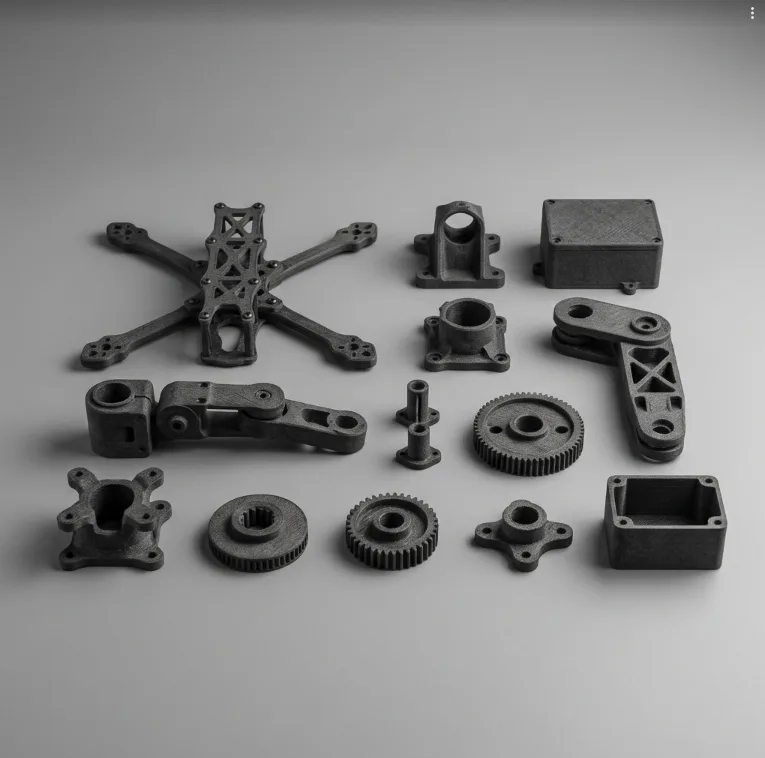
- Carbon-fibre reinforced grades (PLA-CF, PETG-CF, PA6-CF, PA12-CF) add stiffness and reduce weight for structural parts that can’t flex under load, at the cost of some layer adhesion and printer wear.
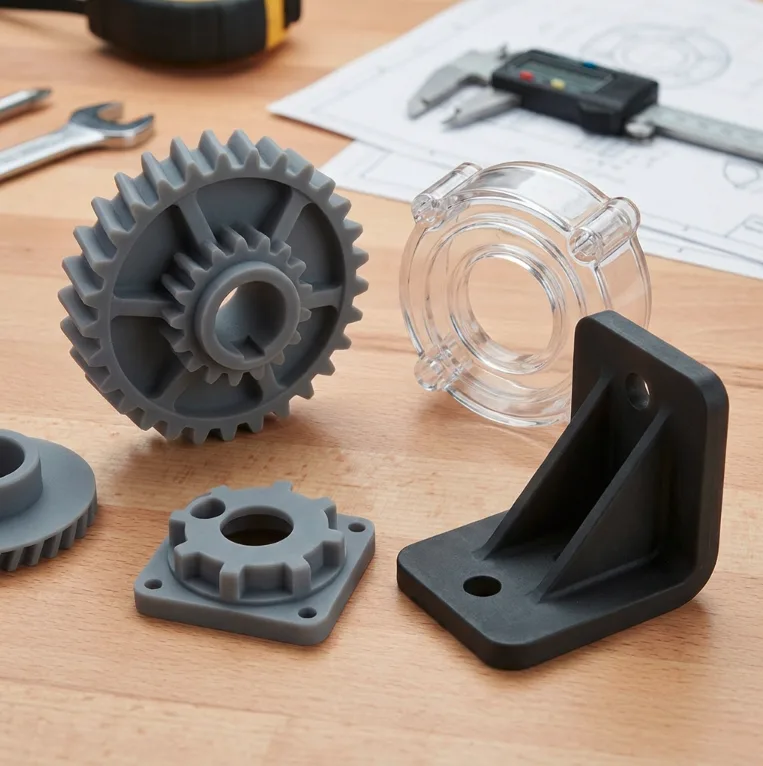
- Standard Resin prints in far finer detail than any filament, down to a 0.05mm layer height with no visible layer lines. This material is for making prototypes or for presentations, not for applications where stresses or mechanical loads are involved.
- Tough Resin is for mechanical-load parts, the ones that would crack if printed in Standard Resin. The functional parts that are being touched by people or manipulated are usually made of Tough Resin.
- Clear Resin is optically transparent, built for lenses, light guides, and display applications where you need to see through the part or pass light through it.
At a glance: which material to use
| Need | Material |
| Cheap prototypes, no stress | PLA |
| Heat and impact resistance | ABS |
| Maximum impact resistance | PC |
| Outdoor and UV exposure | ASA |
| Outdoor and chemical exposure | PETG |
| Flexible, grips and seals | TPU 95A |
| High strength, repeated load | PA6 Nylon |
| Long-term dimensional stability | PA12 Nylon |
| Maximum stiffness, minimum weight | Carbon-fibre grades |
| Visual prototypes, presentation | Standard Resin |
| Functional parts under load | Tough Resin |
| Lenses, light guides, see-through parts | Clear Resin |
Material choice isn’t a checkbox before checkout. It’s the decision that decides whether your part works or gets sent back.
If you’re not sure which of these fits your part, don’t guess and don’t order the cheapest option by default. Talk to Dwart Industries’ 3D printing service before you place the order. Upload your file, tell us what the part needs to survive, and we’ll tell you straight whether the material you picked is right or what to switch to instead.