
Blog
How Stereolithography 3D Printing Is Used in Engineering, Healthcare & Product Design


So here’s a question no one thinks of until it is too late: what do you do when your prototype is flawless on screen but doesn’t work once people start handling it?
It’s the gap between the digital model and the physical part that causes many projects to fail. Not because the idea was wrong. The finished model was smooth on screen but rough, ill-fitting, or plain wrong in the hands. SLA 3D printing (stereolithography) uses light to cure liquid photopolymer resin layer by layer, to create a part where the layers are so thin that they are effectively invisible. This is why engineers use the technology when tight tolerances matter, why dental labs use it every day for surgical guides, and why product designers use it to ensure that the product doesn’t contain defects before it reaches the molding stage.
This blog gives an explanation of where SLA is truly useful, where it is not, and what it can and cannot do for you. Just hang tight, as the choice of material you make here depends on whether your part works or merely appears to.
Why Prototypes Mislead You
Most product failures are small. A snap-fit that’s 0.3 mm off. A surface that photographs fine but feels grainy. A surgical guide that fits the CT scan but not the actual jaw.
Here’s the friction point that nobody talks about enough: The prototyping method you use determines which problems you catch.
FDM printing, the filament-extrusion process most people picture when they hear “3D printing,” is great for structural brackets and functional testing. However, it leaves visible layer lines and may not reproduce fine features. If your part has threads, snap-fits, small text, or a surface that needs to look finished, FDM will hide the very flaws you’re trying to identify. You approve a part that looks fine when printed rough, then encounter problems when the injection-moulded version doesn’t match.
In healthcare, the stakes climb higher. A surgical guide with a 0.3 mm error is a clinical issue. A study comparing SLA- and DLP-printed dental implant guides found SLA guides deviated by roughly 0.29 mm from the CAD design, compared to about 0.09 mm for DLP and 0.35 mm for milled guides on drill-sleeve accuracy across seven print orientations. This is not a criticism of SLA; it’s the point: in this field, the process you choose has measurable clinical consequences, and “close enough” isn’t a real category.
So the real problem isn’t “which 3D printer is best.” It’s this: most teams pick a printing process based on what’s fast or cheap. That mismatch is where budgets increase and timelines extend.
What SLA Actually Gets Right
Stereolithography (SLA) 3D printing, including MSLA/LCD-based systems, uses UV light to cure liquid photopolymer resin layer by layer to create a solid part. Here’s where that precision actually pays off.
Engineering: catching problems before they’re expensive
Engineers print SLA parts to break things on purpose, cheaply, before a supplier does it for them at scale.
- Fit-checks and assemblies. SLA’s tighter dimensional tolerance (commonly around ±0.5%, with a practical floor near ±0.15 mm) means mating parts actually mate.
- Fine mechanical features. Threads down to M3, holes as small as 0.5 mm in diameter, wall thicknesses starting at 0.5 mm when supported.
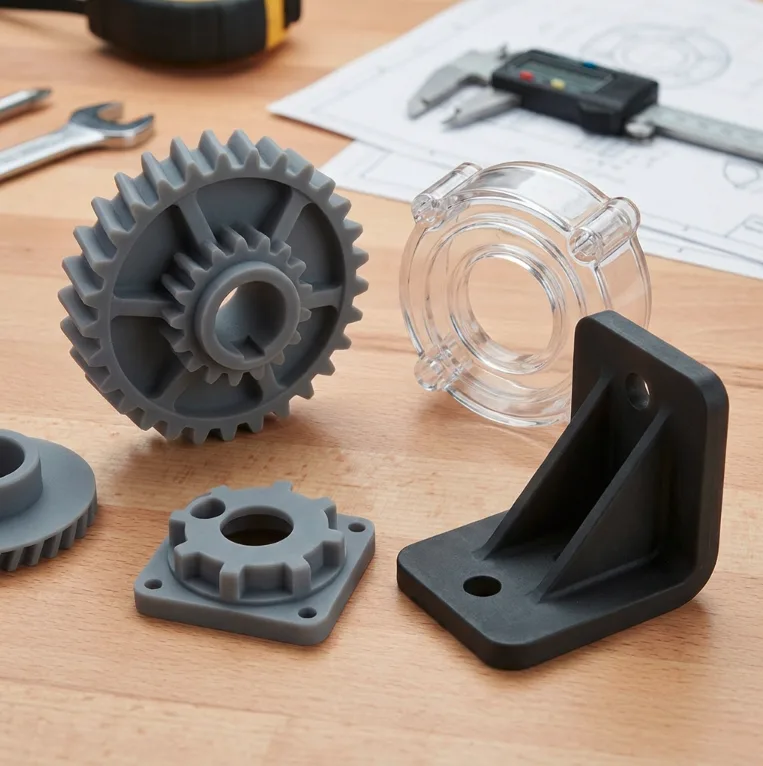
- Functional prototyping with the right resin. This is where material choice stops being a checkbox. Standard resin gives you the sharpest surface detail and finest achievable layers, making it suitable for visual prototypes, master patterns, and fit-checks. But it’s stiffer and more brittle, so it’s the wrong pick for anything that needs to flex or absorb an impact repeatedly. For snap-fits or enclosures that get handled, you’d move to a tougher, impact-modified resin instead.
Healthcare: where tolerance stops being optional
SLA didn’t become a fixture in dental and medical labs by accident. It became one because it produces highly accurate, aesthetically accurate restorations that match surrounding anatomy closely, and because the resin-curing process gives labs repeatable, defensible accuracy.
Common applications include:
- Surgical guides. Digital CT or CBCT data is converted into a guide that positions dental implants with high precision, which matters most in anatomically tricky cases.
- Crowns, bridges, and dentures. SLA can be used to produce dental models, patterns, and certain restorations with the accuracy and aesthetics needed to match the patient’s existing teeth.
- Anatomical models and biocompatible devices. Beyond dentistry, medical-grade resin systems now support patient-specific anatomical models and instrumentation for professionals who need accurate, biocompatible, personalized parts to improve patient care.
SLA isn’t automatically the most accurate option in every dental scenario. In direct testing, DLP guides have outperformed SLA guides on drill-sleeve deviation. If you’re choosing a process for a clinical application, don’t pick SLA because it’s the popular name; pick it because you’ve checked what the specific use case demands.
Product design: the part that tells the truth
Before tooling gets cut, a designer needs a physical object that argues honestly for or against a decision. That’s SLA’s real job in product design:
- Master patterns and vacuum-cast masters. The surface finish can be smooth enough for use in silicone tooling with minimal additional finishing.
- Consumer-facing mockups. Investor demos, trade show samples, and packaging fit-tests all need a part that looks and feels like the real thing.
- Optical and transparent parts. Clear resin variants offer strong light transmission, useful for lens prototypes, light guides, and see-through housings where a frosted FDM part just won’t communicate the idea.
The Limits of SLA
SLA isn’t the answer for everything. It’s more brittle than tough engineering plastics, it is generally more expensive per part than FDM for high-volume production, and its build volume is smaller, so oversized parts need splitting or a different process entirely. If your part needs to survive years of UV exposure outdoors, or you need hundreds of load-bearing units, SLA resin is the wrong tool. Know the job before you pick the process.
Where This Leaves You
If your prototype needs to prove something, whether that’s a fit, a finish, or a clinical tolerance, the printing process you choose is the whole ballgame. Get it wrong, and you’re not testing your design; you’re testing the limitations of the printing process instead.
Dwart Industries offers SLA 3D printing with standard, tough, and clear resin options, with parts quality-checked and shipped across India. Upload your file, pick the resin that actually matches what the part needs to do, and get a part built to prove your design right.
Get an instant SLA quote from Dwart Industries or reach the team directly at sales@dwartindustries.com.