



ASA
ASA — UV Resistant.
Built for Outdoors.
Our ASA 3D printing service India delivers parts engineered to survive the outdoors. Acrylonitrile Styrene Acrylate (ASA) offers exceptional UV, weather, and thermal resistance — resisting yellowing, embrittlement, and surface degradation that destroys ABS in sunlight. With a 92°C HDT and resistance to both acid and alkali, it is the definitive outdoor FDM material.
Get Instant Quote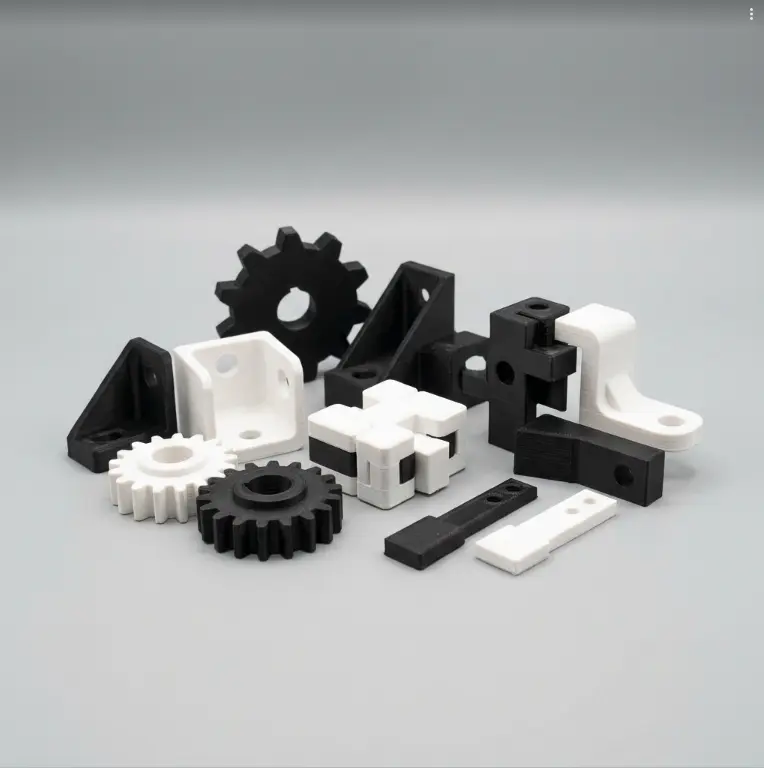
Tap an image to enlarge · swipe for more →
About Our ASA 3D Printing Service India — UV & Weather Resistant FDM
ASA (Acrylonitrile Styrene Acrylate) is the outdoor-grade evolution of ABS. It replaces the butadiene rubber component of ABS with an acrylate rubber that is far more resistant to UV degradation — the mechanism that causes ABS parts to yellow, become brittle, and fail in sunlight over time. Our ASA 3D printing service India is the right choice for any part that will live outdoors.
With a 92°C heat deflection temperature, ASA handles the thermal cycling of outdoor Indian climates — hot summers, monsoon humidity, and cold-season drops — without dimensional change. Unlike most engineering materials, it is resistant to both acid and alkali, making it suitable for garden, agricultural, and chemical-adjacent environments.
ASA prints smoothly with up to 80% cooling fan, a broad nozzle temperature range of 240–270°C, and high print speeds up to 250 mm/s. It also accepts painting and post-processing well, making it the top choice for UV resistant 3D printing India applications requiring colour-matching or custom finishes.
Material Properties
| Property | XY In-Plane | Z Through-Layer | Standard |
|---|---|---|---|
| Young's Modulus | 2450 ± 270 MPa | 2120 ± 260 MPa | ISO 527 |
| Tensile Strength | 37 ± 3 MPa | 31 ± 4 MPa | ISO 527 |
| Breaking Elongation | 9.2 ± 1.4 % | 4.6 ± 0.8 % | ISO 527 |
| Bending Modulus | 1920 ± 130 MPa | 1650 ± 120 MPa | ISO 178 |
| Bending Strength | 65 ± 5 MPa | 40 ± 3 MPa | ISO 178 |
| Impact — Unnotched | 41.0 ± 2.3 kJ/m² | 4.9 ± 0.6 kJ/m² | ISO 179 |
| Impact — Notched | 19.6 ± 1.8 kJ/m² | — | ISO 179 |
XY = in-plane · Z = through-layer · Specimens annealed at 80°C / 12 h per Bambu Lab TDS V3.0.
| Property | Value | Method |
|---|---|---|
| Density | 1.05 g/cm³ | ISO 1183 |
| Melt Flow Index | 7.0 ± 0.8 g/10 min (260°C / 2.16 kg) | — |
| Melting Temperature | 210°C | DSC, 10°C/min |
| Vicat Softening Temperature | 106°C | ISO 306 |
| HDT @ 1.8 MPa | 92°C | ISO 75 |
| HDT @ 0.45 MPa | 100°C | ISO 75 |
| Water Absorption (Saturated) | 0.45% (25°C, 55% RH) | — |
| Print Temperature | 240–270°C | — |
| Bed Temperature | 80–100°C | — |
| Chamber Temperature | 45–60°C | — |
| Cooling Fan | 0–80% | — |
| Max Print Speed | < 250 mm/s | — |
| Pre-drying | 80°C / 8 h | — |
| Max Overhang | ~70° | — |
| Max Bridge | ~40 mm | — |
| Annealing (optional) | 80–90°C, 6–12 h (blast oven) | — |
| Property | Value |
|---|---|
| Composition | Acrylonitrile-Styrene-Acrylate (ASA) |
| UV Resistance | Excellent — designed for prolonged outdoor sun exposure |
| Odour During Printing | Odourless |
| Skin Hazard | No hazard |
| Water Solubility | Insoluble |
| Acid Resistance | Resistant |
| Alkali Resistance | Resistant |
| Organic Solvent Resistance | Not resistant to some organic solvents |
| Oil & Grease Resistance | Not resistant to some oils and greases |
| Flammability | Flammable |
Performance Ratings
Available Colours
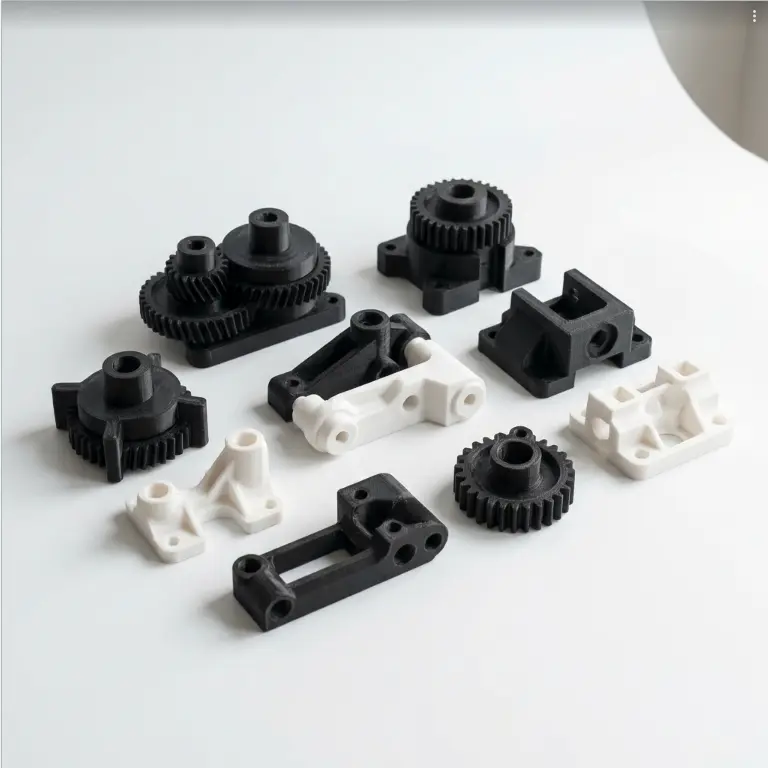
✦ 2 stock colours available (White and Black). ASA colours are UV-stable and will not fade or yellow with outdoor exposure. Contact us for custom colour requirements on bulk orders.
Design Guidelines for ASA
For indoor parts needing higher structural stiffness, PA12-CF or PA6-CF are the right choices. For flexible outdoor parts, TPU 95A offers elasticity but with less UV stability. ASA is specifically the best choice when outdoor longevity + UV stability + good aesthetics are the primary requirements.