



PETG-CF
PETG-CF — CF Stiffness.
Easy to Print.
Our PETG-CF 3D printing service India delivers carbon fibre reinforced PETG parts that punch above their material class. With 2910 MPa bending modulus, 0.30% water absorption (lowest in our portfolio), and a smooth matte CF finish with virtually no warping risk — PETG-CF is the easiest CF material to print and the best choice for functional prototypes and display-grade structural parts.
Get Instant Quote
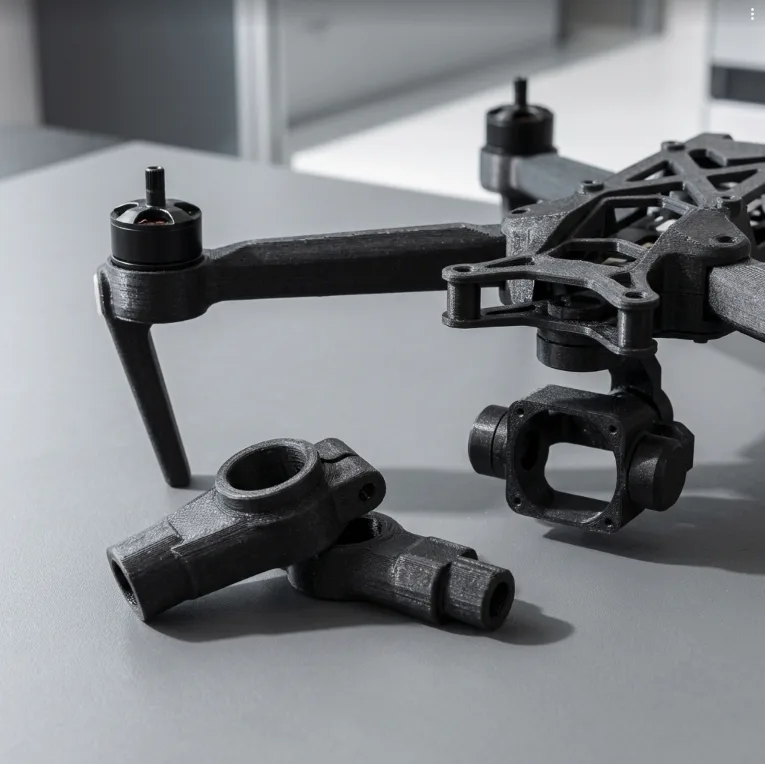

Tap an image to enlarge · swipe for more →
About Our PETG-CF 3D Printing Service India — Carbon Fibre PETG FDM
PETG-CF combines the best-in-class printability and chemical resistance of PETG with the stiffness and premium CF aesthetic of short carbon fibre reinforcement. The result is a material that prints without the warping and delamination issues of engineering CF nylons, while delivering 2910 MPa bending modulus — significantly stiffer than standard PETG. Our PETG-CF 3D printing service India is the right choice when you need the CF look and improved stiffness without engineering-grade complexity.
PETG-CF has the lowest water absorption in our entire portfolio at 0.30% — lower than PA12, PA12-CF, ASA, or ABS. This makes it dimensionally extremely stable across humidity variations, ideal for precision parts in humid or marine environments. It also resists most oils and greases, adding to its utility in mechanical assemblies.
The specially formulated blend minimises nozzle sticking and warping risk while delivering a smooth, consistent print with a premium matte CF finish and nearly invisible layer lines. Combined with up to 60% cooling fan and a moderate bed temperature of 65–75°C, PETG-CF is the most accessible carbon fibre FDM material — ideal for carbon fibre PETG FDM printing India applications requiring aesthetics plus performance.
Material Properties
| Property | XY In-Plane | Z Through-Layer | Standard |
|---|---|---|---|
| Young's Modulus | 2460 ± 230 MPa | 1340 ± 150 MPa | ISO 527 |
| Tensile Strength | 35 ± 5 MPa | 29 ± 4 MPa | ISO 527 |
| Breaking Elongation | 10.4 ± 0.6 % | 4.7 ± 0.4 % | ISO 527 |
| Bending Modulus | 2910 ± 260 MPa | 1560 ± 180 MPa | ISO 178 |
| Bending Strength | 70 ± 5 MPa | 48 ± 4 MPa | ISO 178 |
| Impact — Unnotched | 41.2 ± 2.6 kJ/m² | 10.7 ± 1.6 kJ/m² | ISO 179 |
| Impact — Notched | 15.7 ± 1.6 kJ/m² | — | ISO 179 |
XY = in-plane · Z = through-layer · Specimens annealed at 65°C / 8 h per Bambu Lab TDS V3.0.
| Property | Value | Method |
|---|---|---|
| Density | 1.25 g/cm³ | ISO 1183 |
| Melt Flow Index | 19.3 ± 2.4 g/10 min (250°C / 2.16 kg) | — |
| Melting Temperature | 225°C | DSC, 10°C/min |
| Glass Transition Temperature | 68°C | DSC, 10°C/min |
| Vicat Softening Temperature | 85°C | ISO 306 |
| HDT @ 1.8 MPa | 68°C | ISO 75 |
| HDT @ 0.45 MPa | 74°C | ISO 75 |
| Water Absorption (Saturated) | 0.30% — lowest in portfolio | 25°C, 55% RH |
| Print Temperature | 240–270°C | — |
| Bed Temperature | 65–75°C | — |
| Chamber Temperature | 35–50°C | — |
| Cooling Fan | 0–60% | — |
| Max Print Speed | < 200 mm/s | — |
| Pre-drying | 65°C / 8 h | — |
| Max Overhang | ~70° | — |
| Max Bridge | ~30 mm | — |
| Annealing (optional) | 55–60°C, 65–70 hours (blast oven) | — |
| Property | Value |
|---|---|
| Composition | PETG (Polyethylene terephthalate glycol) with short carbon fibre reinforcement |
| Odour During Printing | Odourless |
| Skin Hazard | No hazard |
| Water Solubility | Insoluble |
| Water Absorption | 0.30% saturated — excellent dimensional stability in humid environments |
| Acid Resistance | Not resistant |
| Alkali Resistance | Not resistant |
| Organic Solvent Resistance | Not resistant to some organic solvents |
| Oil & Grease Resistance | Resistant to most oils and greases |
| Flammability | Flammable |
| Combustion Products | Water, carbon oxides (odourless) |
Performance Ratings
Available Colours
✦ 1 stock colour (Carbon Black). PETG-CF has a smooth, premium matte finish with nearly invisible layer lines. Contact us for bulk order enquiries.
Design Guidelines for PETG-CF
For high-temperature applications (above 68°C), choose PA12-CF or PA6-CF instead. For maximum stiffness, PA12-CF's 4230 MPa bending modulus significantly outperforms PETG-CF's 2910 MPa. PETG-CF is specifically the best choice when you need CF aesthetics + low warping + easiest CF printing + lowest moisture absorption without engineering-grade thermal requirements.