



PLA-CF
PLA-CF — Premium Finish.
Easiest CF Print.
Our PLA-CF 3D printing service India delivers the premium carbon fibre look with the simplicity of PLA printing. Custom-blended tough PLA with carbon fibre achieves a 3950 MPa bending modulus and a matte finish with almost invisible layer lines — making it the top choice for design prototypes, consumer-facing models, and any part that must look exceptional straight off the printer.
Get Instant Quote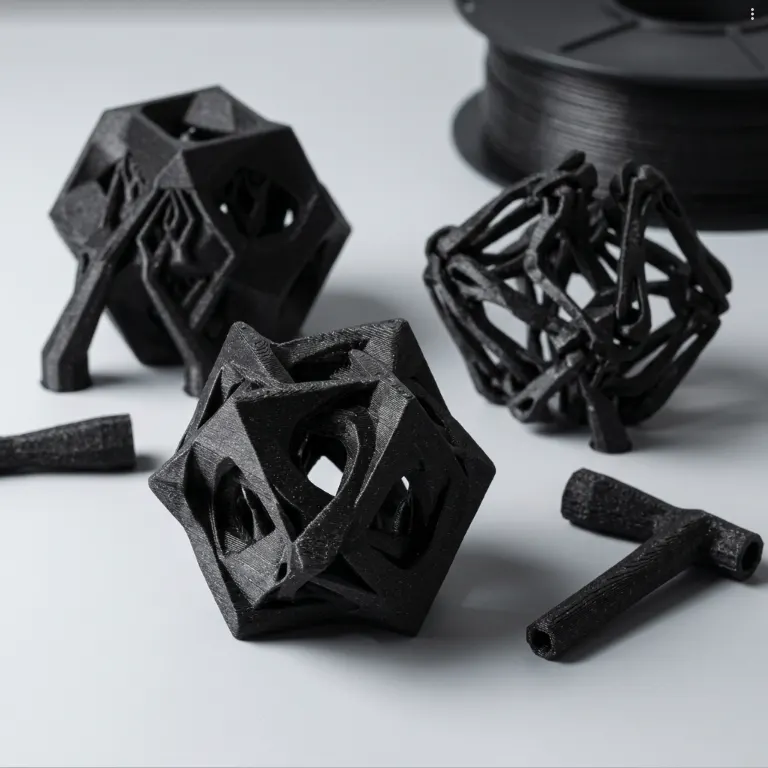
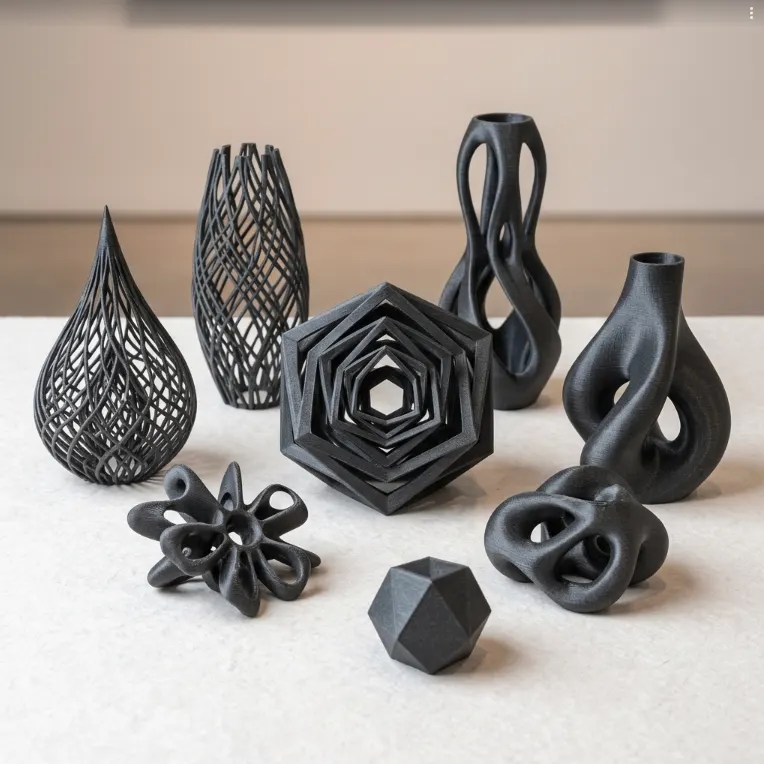
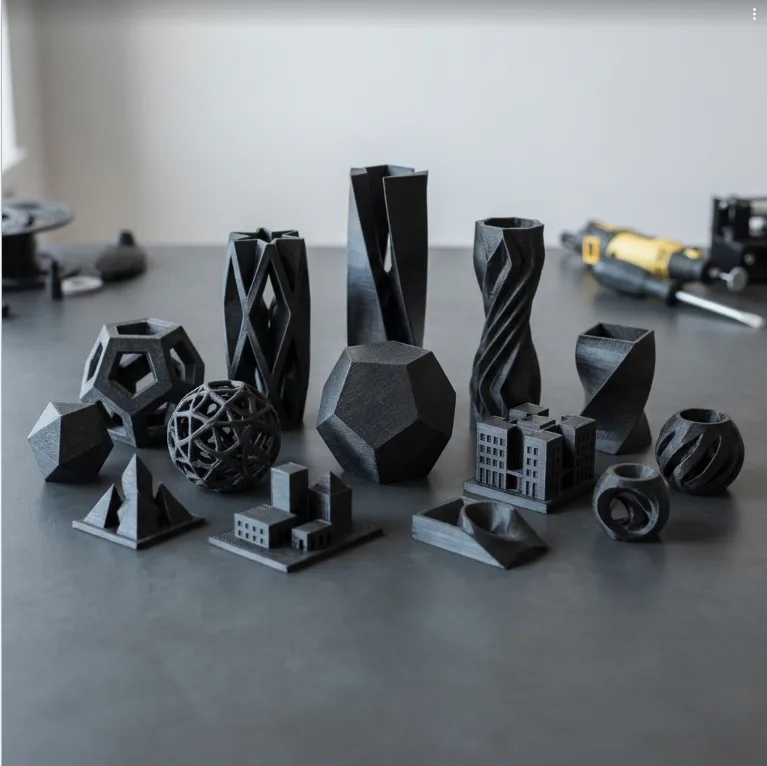
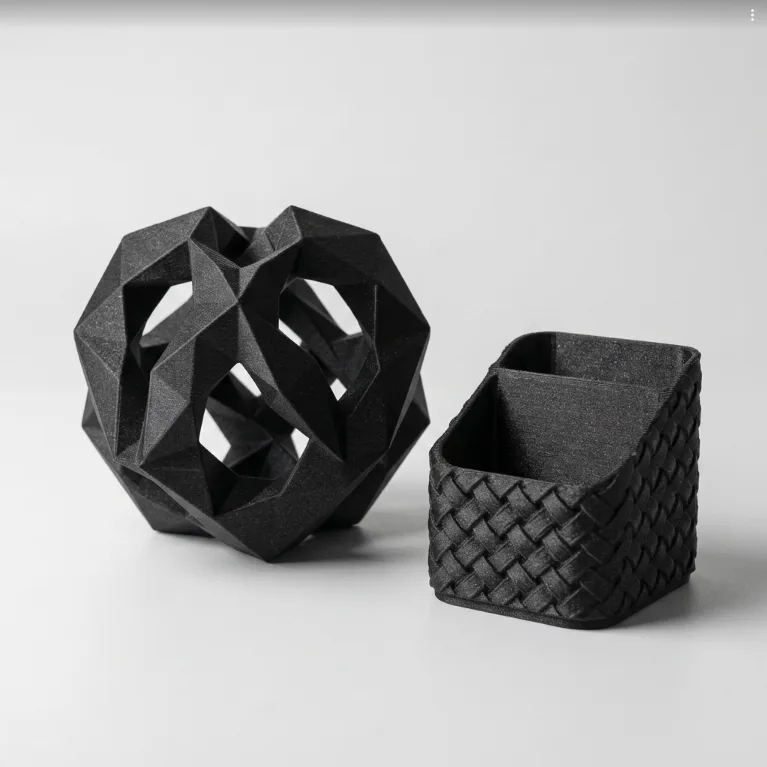
Tap an image to enlarge · swipe for more →
About Our PLA-CF 3D Printing Service India — Carbon Fibre PLA FDM
PLA-CF is a custom-blended tough PLA with carbon fibre reinforcement, designed to maximise stiffness and visual quality while retaining the easy print characteristics of standard PLA. With a 3950 MPa bending modulus XY — among the highest of any easy-print FDM material — PLA-CF delivers structural performance that standard PLA cannot match. Our PLA-CF 3D printing service India is the ideal choice for design-driven applications where aesthetics are as important as function.
The defining characteristic of PLA-CF is its premium matte finish with almost invisible layer lines. Where standard PLA parts have a glossy surface that highlights layer lines, PLA-CF's carbon fibre texture creates a sophisticated dark matte appearance that looks like injection-moulded or machined parts from a distance. This makes it ideal for carbon fibre PLA FDM printing India applications including product design prototypes, exhibition models, and consumer-facing components.
PLA-CF prints at standard PLA temperatures (210–240°C) with active cooling, a low bed temperature of 35–45°C, and no enclosure requirement. It is the easiest CF material to print — no pre-drying chamber, no high bed temps, no warp risk. Pre-drying at 55°C for 8 hours is recommended for optimal surface quality.
Material Properties
| Property | XY In-Plane | Z Through-Layer | Standard |
|---|---|---|---|
| Young's Modulus | 2790 ± 120 MPa | 2160 ± 90 MPa | ISO 527 |
| Tensile Strength | 38 ± 4 MPa | 26 ± 2 MPa | ISO 527 |
| Breaking Elongation | 8.4 ± 3.2 % | 3.6 ± 0.7 % | ISO 527 |
| Bending Modulus | 3950 ± 190 MPa | 2260 ± 180 MPa | ISO 178 |
| Bending Strength | 89 ± 4 MPa | 49 ± 3 MPa | ISO 178 |
| Impact — Unnotched | 23.2 ± 3.7 kJ/m² | 7.8 ± 0.7 kJ/m² | ISO 179 |
| Impact — Notched | 7.6 ± 2.6 kJ/m² | — | ISO 179 |
XY = in-plane · Z = through-layer · Specimens annealed at 55°C / 8 h per Bambu Lab TDS V2.0.
| Property | Value | Method |
|---|---|---|
| Density | 1.22 g/cm³ | ISO 1183 |
| Melt Flow Index | 3.7 ± 0.6 g/10 min (210°C / 2.16 kg) | — |
| Melting Temperature | 165°C | DSC, 10°C/min |
| Glass Transition Temperature | 63°C | DSC, 10°C/min |
| Vicat Softening Temperature | 69°C | ISO 306 |
| HDT @ 1.8 MPa | 54°C ⚠ Not for hot environments | ISO 75 |
| HDT @ 0.45 MPa | 55°C | ISO 75 |
| Water Absorption (Saturated) | 0.42% (25°C, 55% RH) | — |
| Print Temperature | 210–240°C | — |
| Bed Temperature | 35–45°C | — |
| Chamber Temperature | 25–45°C (no enclosure required) | — |
| Cooling Fan | On (full) | — |
| Max Print Speed | < 200 mm/s | — |
| Pre-drying | 55°C / 8 h (recommended) | — |
| Max Overhang | 55° | — |
| Max Bridge | 30 mm | — |
| Annealing (optional) | 55–60°C, 6–12 h (blast oven) | — |
| Property | Value |
|---|---|
| Composition | Polylactic acid (PLA) with short carbon fibre reinforcement |
| Bio-based Content | PLA is derived from renewable resources (corn starch / sugarcane) |
| Odour During Printing | Odourless |
| Skin Hazard | No hazard |
| Water Solubility | Insoluble |
| Acid Resistance | Not resistant |
| Alkali Resistance | Not resistant |
| Organic Solvent Resistance | Not resistant to some organic solvents |
| Oil & Grease Resistance | Resistant to most oils and greases |
| Flammability | Flammable |
| Heat Limitation | 54°C HDT — not suitable for hot environments or direct sunlight |
Performance Ratings
Available Colours
✦ 1 stock colour (Carbon Black). PLA-CF has a premium matte finish with near-invisible layer lines — the best visual FDM finish straight off the printer. Contact us for bulk enquiries.
Design Guidelines for PLA-CF
PLA-CF will deform at 54°C — it cannot be used in hot cars, direct sunlight (surface temps can exceed 60°C in Indian summers), near heat sources, or in any application where temperature exceeds 50°C. For those applications, choose PETG-CF (68°C HDT) or PA12-CF (170°C HDT). PLA-CF is strictly an indoor, room-temperature, aesthetics-first CF material.