
Blog
5 Powerful Ways Custom 3D Printing Services Accelerate Product Development

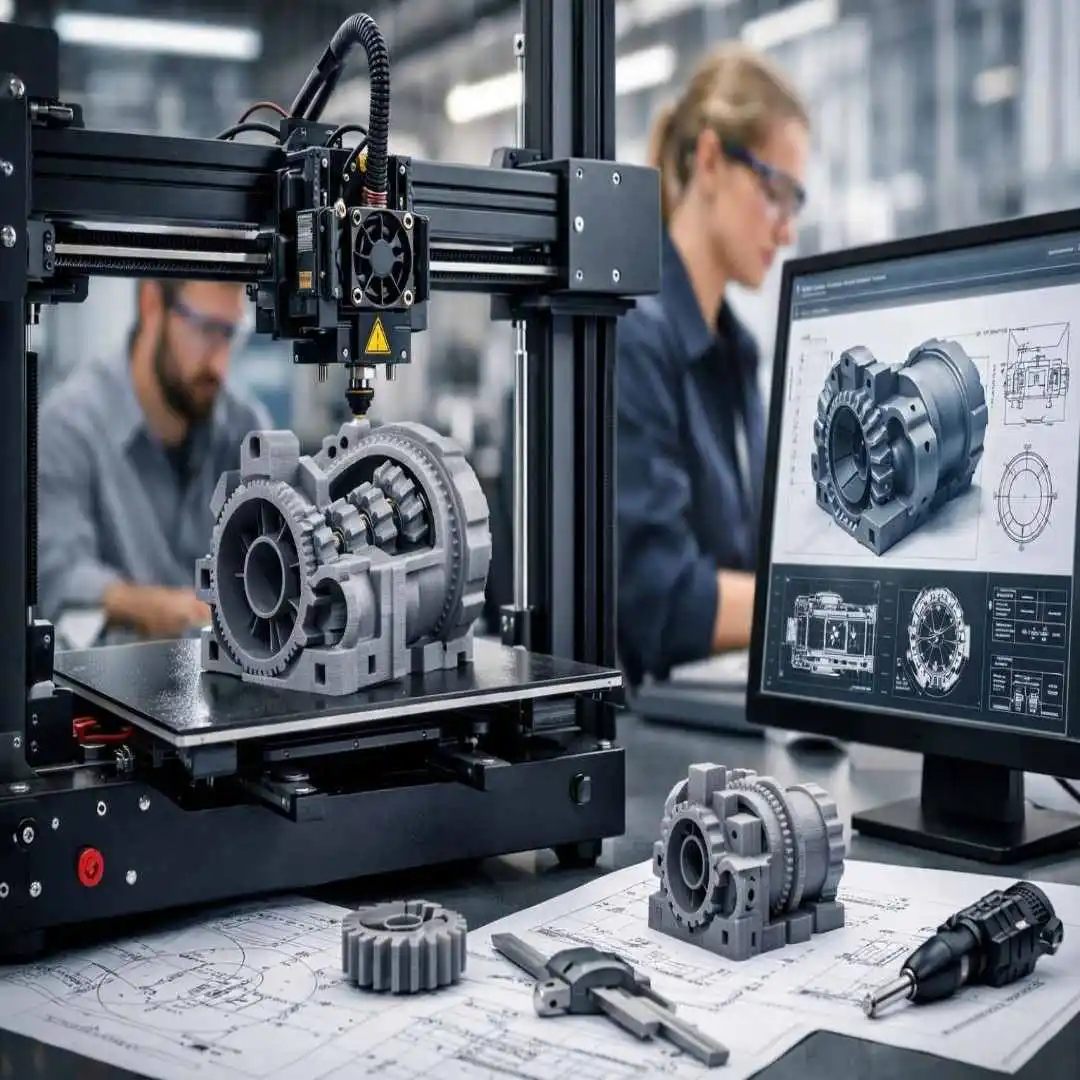
3D printing services for custom solutions can help speed up product development in a number of ways. The print is the short one. It is surrounded by delays. A waiting period is used for a quote. You wait for someone to report that the file is broken. If a part arrives in the wrong material, the loop restarts. Every pass takes days, and a launch date has a fixed number of days. This post names four places where product teams lose time and five features of an online 3D printing service that shorten the loop. You receive the figures a provider ought to give you, so that you can review any provider before uploading a file.
What Slows Down Product Development : Custom 3D Printing Services
The process of making a product is iterative, consisting of design, make, test, fix. 3D printing and prototyping reduce the make step. There are four places where teams lose that gain: A quote waits in an inbox. A thin wall is noticed by a reviewer after the part is printed. A test part is made of a stand-in material; the result is of little value. A part is put on the bench without being checked. If you shorten those four, the loop will shrink.
Five ways a custom 3D printing service shortens the loop
There are five ways that a bespoke 3D printing service can reduce the loop.
1. Price and date before you commit
A good online 3D printing provider quotes the cost from the file. Upload an STL/STEP file, choose the material, and read the price. The production and delivery estimate is shown on the checkout page. Production at the provider below is 1-5 working days for FDM and 1-3 for SLA, counted from order confirmation, and large orders can take 1-3 extra days. Typical delivery is 2-8 days after dispatch. You make plans for the next test using a real date.
2. An engineer reads the file before the printer does
A broken file burns a full cycle. A mechanical engineer at the provider cited below checks wall thickness, overhangs, trapped volumes, fine features, and mesh errors before printing. If the file fails, the customer hears before production starts.
3. The real material, from the first part
Custom 3D printing services let you test in a material that matches your end use, whether you want ASA for sun or TPU 95A for flex. The provider cited below offers 18 materials across FDM and SLA. Tolerance matters: typical tolerance is ±0.1 mm per 100 mm on FDM and ±0.15 mm on SLA. Design to those numbers.
4. Variants in one order
Small runs are expensive when a process needs tooling. ISO/ASTM 52900 describes additive manufacturing as building 3D geometry by successive addition of material. No mold or die goes into the process, so no tooling is needed. In the list of custom 3D printing India providers, seek out bulk upload. The provider cited below takes up to 30 different parts in one checkout. Take four different designs of brackets and test these on one bench day.
5. Approve the part before it ships
Free image review: if you choose it at checkout, the images of your completed parts are displayed on your order page. You either approve or flag a concern, and the part stays with the provider until you approve it or the provider reworks it from your feedback. If a print fails on their side, it is reprinted at their expense, and they let you know if the delivery date is changed.
The limit
The properties of printed parts are different from those of moulded or machined parts. Use prints to find design errors in first trials. Confirm the final material and process before production.
Request a service
Inspect files for format and content, and order a service with Dwart Industries. Go to the FDM instant quote page or SLA instant quote page and upload your file, and read the delivery estimate at checkout.
Assemblies or load-bearing parts are sent via the B2B support page to an engineer who will provide a formal quotation within one working day. Send the file. Your next test part is waiting on it.